Dying is Easy, Comedy is Statistically Impossible: An IMDbayes Analysis
This analysis was built by a Software Engineer relying on 8-year-old university memories of statistics. If the math looks wrong, just assume it's a feature, not a bug. You can always contact me.
Deconstructing Hollywood: A Data Science Journey from Raw Data to p99 Insights
As software engineers, we are used to deterministic systems. If a = b, then a equals b.
Data Science, however, deals with probability, distributions, and noise.
It's less about "what is the answer" and more about "how confident are we in this trend?"
Recently, I wanted to bridge my engineering background with data science to answer a simple pop-culture question: How do different movie genres actually perform?
Are "Action" movies inherently rated lower than "Dramas"? Is it harder to make a masterpiece "Horror" movie than a masterpiece "Biography"?
To answer this, I didn't just want to run a script; I wanted to build a production-grade Data Science lab?!. (/s) This post details the entire journey—from choosing the modern Python stack and engineering the data pipeline to defining the statistical metrics that reveal the "truth" behind average ratings.
Part 1: The Engineering Foundation
A data project is only as good as its environment. I wanted a setup that was fast, reproducible, and clean.
The Stack Decision
I chose Python because it is the undisputed lingua franca of data science. The ecosystem (Pandas for data crunching, Seaborn for visualization) is unmatched.
The Package Manager: Why uv?
Traditionally, Python data science relies on Conda because it manages complex C-library dependencies used by math libraries like NumPy. However, Conda can be slow and bloated.
For this project, I chose uv.
uv is a modern, blazing-fast Python package manager written in Rust.
It replaces pip, poetry, and virtualenv. It resolves dependencies in milliseconds and creates deterministic environments instantly.
For a project relying on standard wheels like Pandas, uv provides a vastly superior developer experience.
bash# Setting up the environment took seconds $ uv init movie-analysis $ uv python install 3.10 $ uv add pandas matplotlib seaborn scipy jupyter ipykernel
Then connected VS Code to this .venv created by uv, giving me a robust Jupyter Notebook experience right in the IDE.
Part 2: The Data Pipeline (ETL)
I needed data with genres, votes, and ratings, went straight to the source: the IMDb Non-Commercial Datasets.
Then I faced a classic data engineering challenge: these are massive TSV (Tab Separated Values) files. Loading the entirety of IMDb into RAM on a laptop is a bad idea.
Solution? Build a Python ETL script to handle ingestion smartly:
- Stream & Filter: used Pandas to read the raw files in chunks, filtering immediately for
titleType == 'movie'and excluding older films. This kept memory usage low. - Merge: joined the
title.basics(genres/names) withtitle.ratings(scores/votes) on their unique IDs. - The "Explode": This was the crucial data transformation step. IMDb lists genres as a single string: "Action,Adventure,Sci-Fi". To analyze by category, I had to split that string and "explode" the dataset, duplicating the movie row for each genre it belongs to.
python# Transforming "Action,Comedy" into two distinct analysis rows df['genres'] = df['genres'].str.split(',') df_exploded = df.explode('genres')
Part 3: The Science (Beyond Averages)
With clean data in hand, we moved into a Jupyter Notebook for Exploratory Data Analysis (EDA).
1. Removing the Noise (The Long Tail)
If you average every movie on IMDb, your data is polluted by home videos with 5 votes from the director's family. In statistics, vote counts often follow a "Power Law" or long-tail distribution.
To analyze global sentiment, we had to filter out the noise. We set a threshold, dropping any movie with fewer than 100 votes. This ensured our statistical analysis was based on titles with a minimum level of public engagement.
2. Visualizing the Truth (The Box Plot)
A simple average rating is misleading. If a genre has many 1/10s and many 10/10s, the average is 5/10 - but that doesn't tell the story of how polarizing it is.
I used a Box Plot to visualize the distribution. It shows the median (the center line), the Interquartile Range (the colored box containing the middle 50% of data), and outliers (the dots).
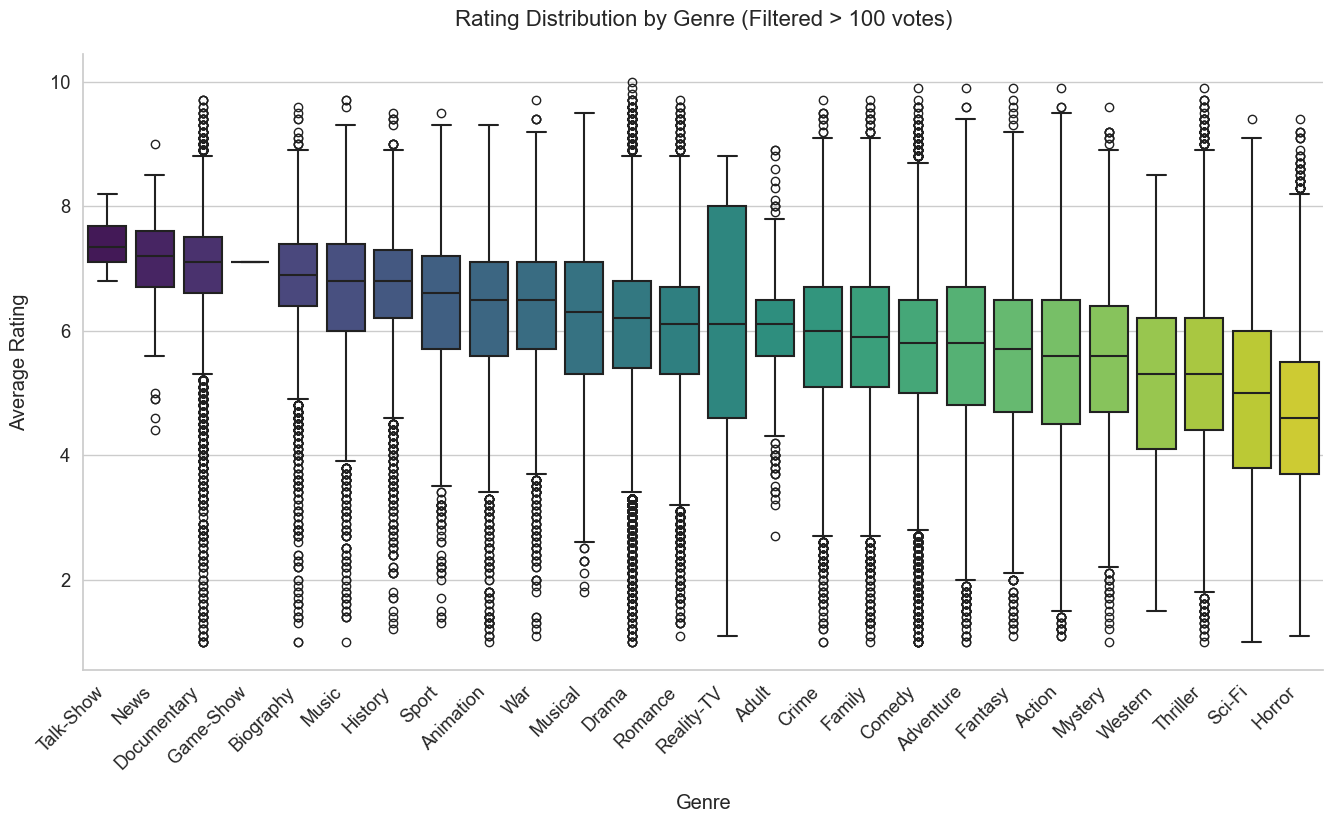
Initial Observations:
- Documentary/Biography: High medians, compact boxes. They are consistently rated highly.
- Horror: The lowest median and a wide spread. It’s very easy to make a bad horror movie.
3. The Metrics: Weighted Ratings & p99
To get deeper insights, I needed better math than simple means.
Metric A: The Weighted Rating (Bayesian Average)
How do you compare a movie with a 9.0 rating and 105 votes against an 8.2 rating with 500,000 votes? The latter score is more statistically significant.
I adopted IMDb's own Weighted Rating formula. This "Bayesian average" pulls a movie's rating toward the global average if it has few votes , letting the observed rating contribute more as the vote count grows relative to .
Where:
- = Average Rating of the movie
- = Number of votes for the movie
- = Minimum votes required to be listed (Threshold: 100)
- = Mean vote across the whole dataset
This provided a fair "Quality Score" for every movie.
Try the weighted score
Adjust the sample movie's rating and vote count below. Both films use the same prior mean and weight. Here, m = 100 is the weight chosen for this analysis; its influence decreases smoothly as votes accumulate. The displayed prior of 6.5 is an illustrative input, not a newly measured dataset average.
This follows the published IMDb Top 250 weighted-rating formula . IMDb's general title-rating algorithm is not disclosed, so this experiment demonstrates the formula used in this article rather than reproducing a live IMDb score.
Loading probability experiment…
Metric B: The p99 Ceiling
I wanted to know the "potential" of a genre. Even if most Action movies are mediocre, how good are the very best ones?
For this, I calculated the 99th Percentile (p99) rating for each genre. This is the rating value below which 99% of the genre falls. It represents the elite tier, the "Masterpiece Ceiling."
Part 4: The Deductions (The Gap Analysis)
By combining the Average Weighted Rating (the typical experience) and the p99 Rating (the elite potential), we created a "Gap Analysis" chart.
The dark green bar is the average quality. The total height of the bar is the p99 ceiling. The light green area represents the "Masterpiece Gap".

The Data Science Deductions
This single chart reveals the "personality" of every genre:
-
The "Safe Bets" (Documentary, History, Biography): They have very high averages (tall dark bars) and a small gap to the ceiling. Deduction: It is difficult to make a poorly rated documentary. Audience selection bias likely plays a role here (people only watch docs on topics they already like).
-
The "High Risk / High Reward" (Horror, Sci-Fi): They have the lowest averages (short dark bars), indicating the typical output is poor. However, their p99 ceilings remain high. Deduction: The gap is huge. It is incredibly difficult to execute these genres well, but when it's done right (e.g., Alien, The Exorcist), they are revered just as highly as dramas.
-
The Animation Anomaly: Animation has a high average and a very high ceiling. Deduction: Statistically, this is perhaps the most consistently high-quality genre in modern cinema.
Conclusion
This project demonstrated that with a solid engineering setup using modern tools like uv,
and by applying statistical concepts beyond simple averages, we can uncover nuanced truths hidden in raw data.
Averages tell you what is probable; distributions and percentiles tell you what is possible.
Question A: Which genre is "easier" to make? (Action vs. Drama vs. Comedy)
The Data Verdict: It is significantly "easier" to make an acceptable Drama than an acceptable Action or Comedy movie.
- Evidence: Look at the box plot, kindly.
- Drama has a high median and a "tight" box (smaller Interquartile Range). This means even "average" Dramas are usually rated around 6.5–7.0. The "floor" is high.
- Action has a lower median. Action movies require budget, stunts, and effects. If those look cheap, the rating tanks immediately. A bad drama is just "boring" (5/10); a bad action movie looks "broken" (3/10).
- Comedy is arguably the hardest to get a high rating for. Humor is subjective. If a joke lands for 50% of the audience but annoys the other 50%, the rating averages out to a 5.0. Drama is universal; Comedy is divisive.
Question B: Should I use lower search bounds for Comedy compared to Drama?
The Data Verdict: YES. Absolutely.
- The "Genre Inflation" Factor: Users rate genres differently. A 7.0 in Horror or Comedy is effectively an 8.0 in Drama or Biography.
- The Strategy: If you filter for
Rating > 7.5, you will see hundreds of Biographies, but you will filter out some of the funniest Comedies ever made (which often sit at 6.8 - 7.2). - Action/Comedy Filter: Set your threshold to 6.5.
- Drama/Doc Filter: Set your threshold to 7.5.
- The Strategy: If you filter for
Question C: The "Blindfold Test" (Documentary vs. Sci-Fi)
The Data Verdict: You will be statistically safer picking the Documentary.
-
The "Floor" Concept: Look at the "Whiskers" (the lines extending from the boxes) on the box plot.
- Sci-Fi: The bottom whisker goes deep down (towards 1.0 or 2.0). There is a significant statistical probability that a random Sci-Fi movie is unwatchable garbage.
- Documentary: The bottom whisker rarely dips below 5.0 or 6.0.
-
The Psychology:
- Documentaries are usually made by passionate experts about specific topics. They rarely "fail" completely.
- Sci-Fi is high-risk. It attempts to build new worlds. When that fails, it looks ridiculous, leading to "hate-watching" and 1-star reviews.
- Conclusion: If you are tired and just want a "guaranteed decent watch" (Low Variance), pick Documentary. If you want to gamble for a potentially mind-blowing experience (High Variance), pick Sci-Fi.
You can check the project here: IMDbayes